
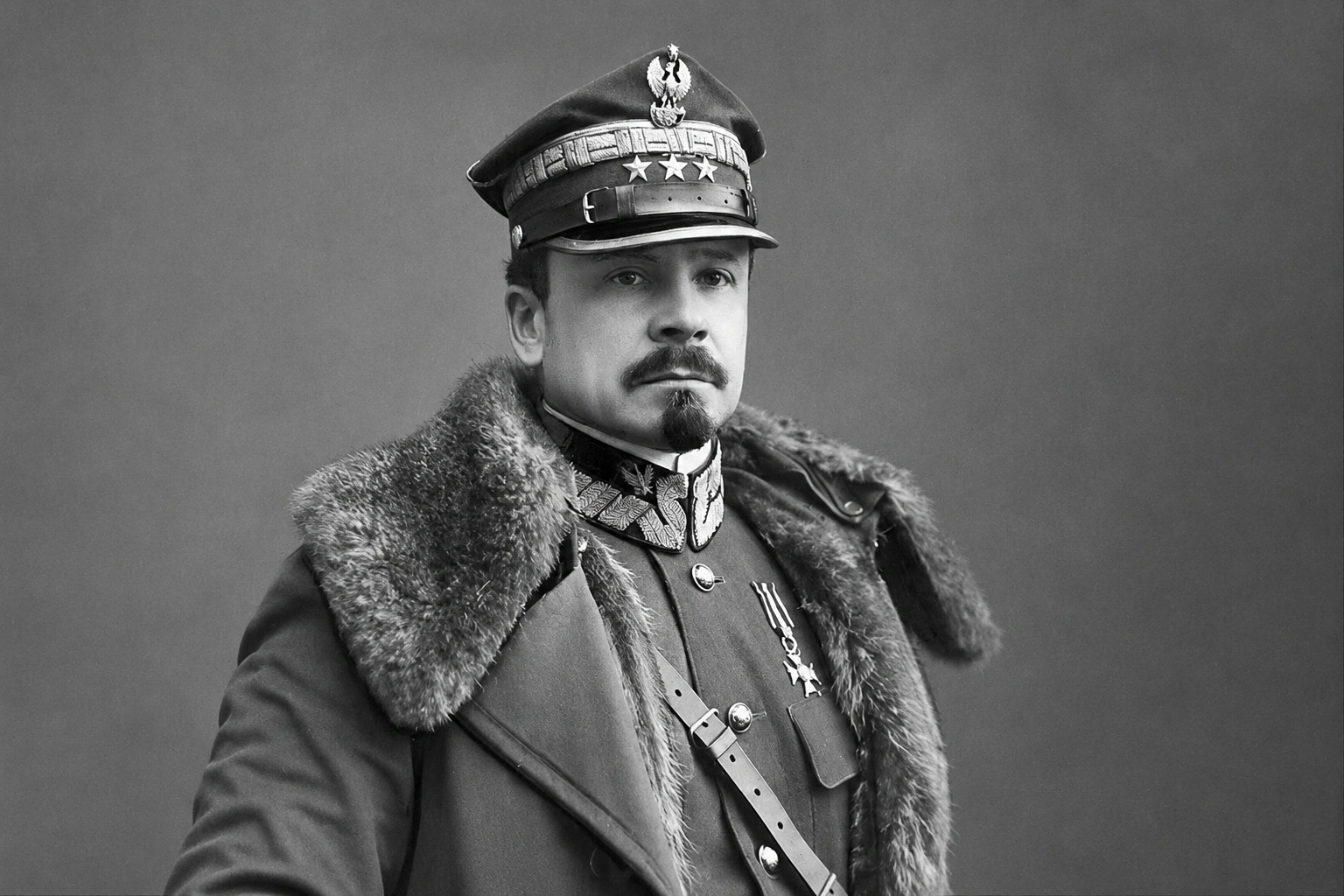
Born on 13 August 1873 in Jurczyce, near Kraków, Józef Haller — an officer in the Austro-Hungarian army who then joined the Polish military formations — took command in 1918 of the Polish Army in France, the "Blue Army", which he brought back to Poland in 1919. He became one of the leading military figures of the reborn Poland.
From the Austro-Hungarian army to the Polish formations
After military and technical training in Vienna, Józef Haller served in the Austro-Hungarian army. At the beginning of the First World War, he joined the Polish military formations and, in particular, commanded the 2nd Brigade of the Polish Legions.
In 1918, after the battles of Rarańcza and Kaniów and the dissolution of the 2nd Polish Corps, Haller made his way to the West. He arrived in France in 1918 and established contact with the Polish National Committee, which at that time played a central role in organising Polish political and military representation before the Allied powers.
Command of the Polish Army in France
The Polish Army in France had been created in 1917. On 4 June 1917, a decree of the President of the French Republic had made possible the formation of a Polish army on French territory. Its first commander was the French general Louis Archinard.
On 4 October 1918, Józef Haller was appointed to head this army. From that date, his name became closely associated with what would soon be called the "Błękitna Armia" — the Blue Army, on account of the colour of its uniforms.
This army brought together Poles from several parts of the world. Volunteers arrived notably from the United States, Canada and Brazil. Poles who had served in the armies of the Central Powers and been taken prisoner also joined its ranks after their release.
Under Haller's command, the army continued its training and organisation. After the armistice of 11 November 1918, its numbers kept growing. The Blue Army had substantial equipment supplied by France and became a considerable military force. On the eve of its transfer to Poland, it numbered about 70,000 soldiers.
The Blue Army comprised, among other units, several large infantry formations, artillery units, air units and a tank regiment. The Polish Ministry of Defence states that it comprised two corps, four divisions, a training division, a tank regiment, seven air squadrons and support units.
Its importance extended beyond the purely military sphere. According to the Polish Institute of National Remembrance (IPN), the existence of this armed force also contributed to the political weight of the Polish cause at the Paris Peace Conference. It constituted one of the principal military instruments available to Poland at the moment when its independence was being restored.
The return of the Blue Army to Poland
In the spring of 1919, the Polish government and the Allied authorities organised the transfer of the Blue Army to Poland.
Transport was a significant diplomatic question. The plan for a maritime transfer to Gdańsk was in particular considered, but it met with opposition from Germany and Great Britain. The solution finally adopted was transport by rail across Germany, organised under Allied protection. The trains carried the soldiers together with their weapons and equipment.
From April 1919, the units placed under General Haller's command thus began to reach Poland. This arrival provided the Polish state with a large force, organised, trained and equipped according to French military standards.
The return of the Blue Army represented a major reinforcement for the Polish military forces, at a time when the young Republic had to face several conflicts concerning its borders.
Haller on the fronts of the reborn Poland
After his return to Poland, Józef Haller was given new military responsibilities.
The units of the Blue Army took part in the fighting of the Polish-Ukrainian War and, subsequently, in the Polish-Soviet War. The Blue Army was then an important component of the military forces of newly independent Poland.
General Haller commanded, among other commands, the Volhynia-Galicia Front, before being given command of the Pomeranian Front. This last mission came in the context of the implementation of the territorial provisions of the Treaty of Versailles concerning Poland.
In February 1920, Haller took part in the ceremonies marking Poland's taking possession of Pomerania. On 10 February 1920 in Puck, he presided over the ceremonies known as "Poland's Wedding to the Sea", a symbol of Poland's regained access to the Baltic Sea.
The Blue Army integrated into the Polish Army
The Blue Army was not an army lastingly separate from the national army. Its units were gradually integrated into the structures of the Wojsko Polskie, the army of the Republic of Poland.
On 1 September 1919, the soldiers of the Blue Army were officially integrated into the structures of the Polish Army, and the Blue Army ceased to exist as a distinct formation.
This integration enabled Poland to retain within its army the experience, equipment and organisation these units had acquired in France.
Haller's role during the Polish-Soviet War
In 1920, Józef Haller took part in the defence of Poland during the Polish-Soviet War.
He played a role in particular in organising the Volunteer Army, created at a time when Poland had to mobilise substantial forces to face the Soviet offensive. He also held command responsibilities on the North-Eastern and Northern fronts. The IPN highlights in particular his role in strengthening the morale of Polish soldiers during this period.
The experience acquired in France and the return to Poland of a large and well-equipped army thus contributed to the military strengthening of the Polish Republic during the early years of its independence.
Pomerania and the "encounter with the sea"
Józef Haller's role was not limited to his command of the Blue Army.
After the First World War, he became one of the officers charged with implementing the new territorial realities of independent Poland. At the head of the Pomeranian Front, he took part in taking possession of the territories allotted to Poland by the Treaty of Versailles.
The Puck ceremony of 10 February 1920 takes on a particular dimension in Polish national memory. It symbolises Poland's reopening onto the Baltic Sea, after more than a century of the Polish state's disappearance from the political map of Europe.
After the fighting
After the period of the wars for Poland's borders, Józef Haller continued his military, political and social engagement.
He held various responsibilities in Polish public life and remained particularly associated with the former soldiers of the Blue Army, with veterans' movements and with the Polish scouting movement.
After his opposition to the May 1926 coup d'état, he was placed on retirement on 31 July 1926.
When the Second World War broke out in September 1939, Haller left Poland and made his way to the West. He took part in the Polish government-in-exile led by General Władysław Sikorski and, in particular, held ministerial functions in London.
After the war, he remained in Great Britain. Józef Haller died in London on 4 June 1960. He was first buried in Gunnersbury cemetery. In 1993, his ashes were transferred to Poland and laid to rest in the Church of Saint Agnes in Kraków.
A major figure in Franco-Polish relations
In Franco-Polish history, Józef Haller occupies a special place.
His career was directly linked to Franco-Polish military cooperation during the First World War. It was in France that the Polish Army was organised, of which he took command in October 1918. Formed, equipped and trained on French territory, this force was then transferred to Poland in 1919 and took part in the fighting the young Republic had to face.
The Blue Army thus constituted a concrete military link between France, Poland and the Polish communities established abroad. The IPN also emphasises that this army represented an important manifestation of the bond between the Polish diaspora and Poland.
For this reason, General Józef Haller remains associated with the memory of the Polish Army in France, with the Blue Army, with the rebirth of the Polish state in 1918 and with the fighting waged to consolidate the borders of the Second Polish Republic.
Sources : Source: Polish Institute of National Remembrance (IPN), "General Józef Haller (1873–1960)".