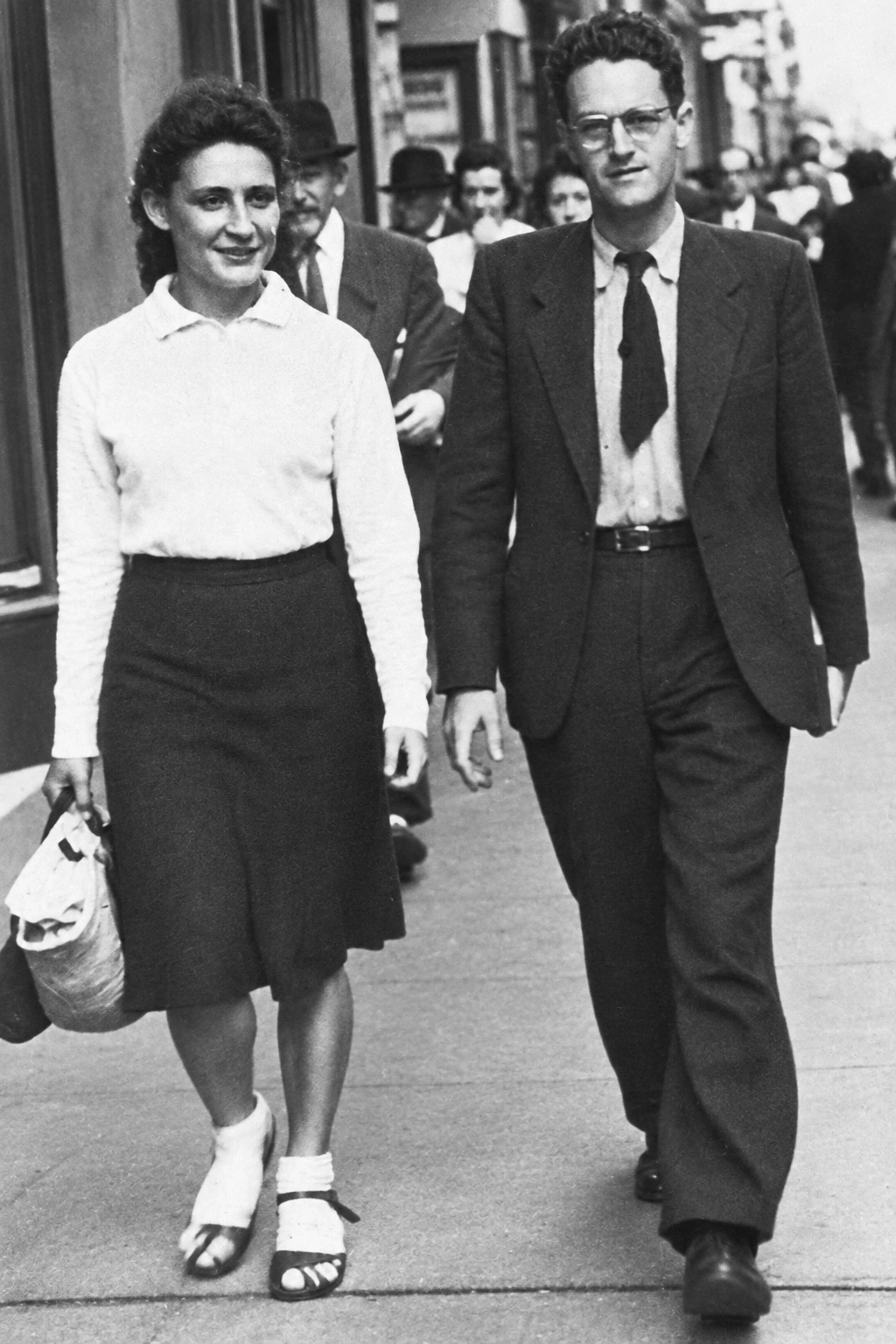
A Polish officer who joined the Polish army being reconstituted in France, Victor Bardach — Jan Gerhard — became one of the leaders of the FTP-MOI Resistance in south-western France, before commanding a Polish unit within the 1st French Army.
A Polish youth swept up by war (1921-1940)
Victor Bardach, known as Jan Gerhard (or Jean), was born on 17 January 1921 in Lwów, Poland, in Eastern Galicia. After secondary school, he became an officer cadet in 1939. His fate changed when, on 1 September 1939, Hitler invaded Poland and seized its western part, in accordance with the terms of the German-Soviet Pact. Defeat came swiftly, and Gerhard’s military unit withdrew to Romania.
Learning that a Polish army was being reconstituted in France, he managed to reach France via Hungary, Yugoslavia and Italy. He joined the Poles gathered at Coëtquidan. During the German attack on France on 10 May 1940, he fought with the 1st Polish Grenadier Division (Lorraine Division) in the Vosges. Wounded at Gérardmer on 23 June, he was imprisoned in Stalag XVII, at Keisersteinbruch near Vienna in Austria.
From the Stalag to the Resistance (1941-1942)
In early January 1941, he learned that the Vichy government had requested the repatriation of hospitalised French prisoners of war. As a French speaker, he managed to slip into a contingent of Frenchmen being repatriated to France. On his arrival in February, he was hospitalised in Lourdes. Taken in charge by the Polish Red Cross and then demobilised, he was placed under house arrest in Montpellier.
There, under the name Jean Halpern, he organised a group of young members or sympathisers of the Polish Communist Party (KPP), including two demobilised Polish officers, Léon Geist and Henri Epstein, as well as Rozman and Kamilia Chylinska. This group was in contact with the Communist Party, probably through its Jewish section. He was also connected with a network smuggling Jewish children into Switzerland. Gerhard took part in several rescues.
At the head of the 35th FTP-MOI Brigade (1942-1944)
Shortly after 11 November 1942 and the invasion of the so-called free zone, Jean Gerhard was sent to Toulouse. He used papers under the name Marc-André Verheggen, a Swiss citizen working as a sales representative. He was put in contact with the 35th FTP-MOI Brigade, then being formed under the command of the Pole Marcel Langer. After Langer’s arrest on 6 February 1943, he replaced him. He became regional military commander and then military commander of Inter-region 35, comprising six departments.
Under his impetus, the 35th Brigade stepped up its operations: attacks on German soldiers, sabotage of equipment, installations and communication routes. Police officers, Vichy officials and political parties supporting collaboration were also targeted. For the period February-May 1943, the 35th Brigade claimed 88 actions in the Haute-Garonne and 71 in the Lot-et-Garonne.
Liberation and return to Poland (1944-1945)
In March 1944, Jan Gerhard was transferred to northern France to take command of the Polish detachments of the FTPF.
At the beginning of 1945, he was appointed commander of the 19th Polish Infantry Group (19th GIP), incorporated into General de Lattre de Tassigny’s 1st French Army. He took part in the Alsace campaign and the Germany campaign. After the Victory, the 19th GIP returned to Poland. He paraded under arms in Warszawa on 18 November 1945.
The post-war years and a tragic end
Back in socialist Poland at the end of the war, Jan Gerhard was sent in 1947 to fight Ukrainian nationalists. From 1948 to 1950 he trained at the Moscow military academy and returned to Poland with the rank of colonel. It was on his return that his troubles began. Like others of his former comrades, he was one of the victims of Stalinism and the onset of the Cold War. Arrested on 29 August 1952, accused of being a French agent, he was released and rehabilitated in 1954. He was elected a deputy to the Polish Sejm after the liberalisation of 1956. He became a novelist and a magazine editor. But in 1971 he was murdered in his Warszawa apartment: the crime was never solved, and here too grey areas remain. The Poland of that time was experiencing a resurgence of antisemitism, and it was rumoured that he was ready to reveal information about the massacres of workers in Gdańsk and Gdynia in 1970.
Sources : Author: André Magne. Sources and bibliography: Service Historique de la Défense (Vincennes), GR 16 P 252565 (individual file); Archives Nationales, 72 AJ 73, file no. 9; Jean-Yves Boursier, La guerre de partisans dans le sud-ouest de la France 1942-1944 — La 35ᵉ Brigade FTP-MOI, Paris, L’Harmattan, 1992; Michel Goubet, “Bardach Victor (Jan Gerhard)”, CD-ROM La Résistance en Haute-Garonne, AERI, 2009.