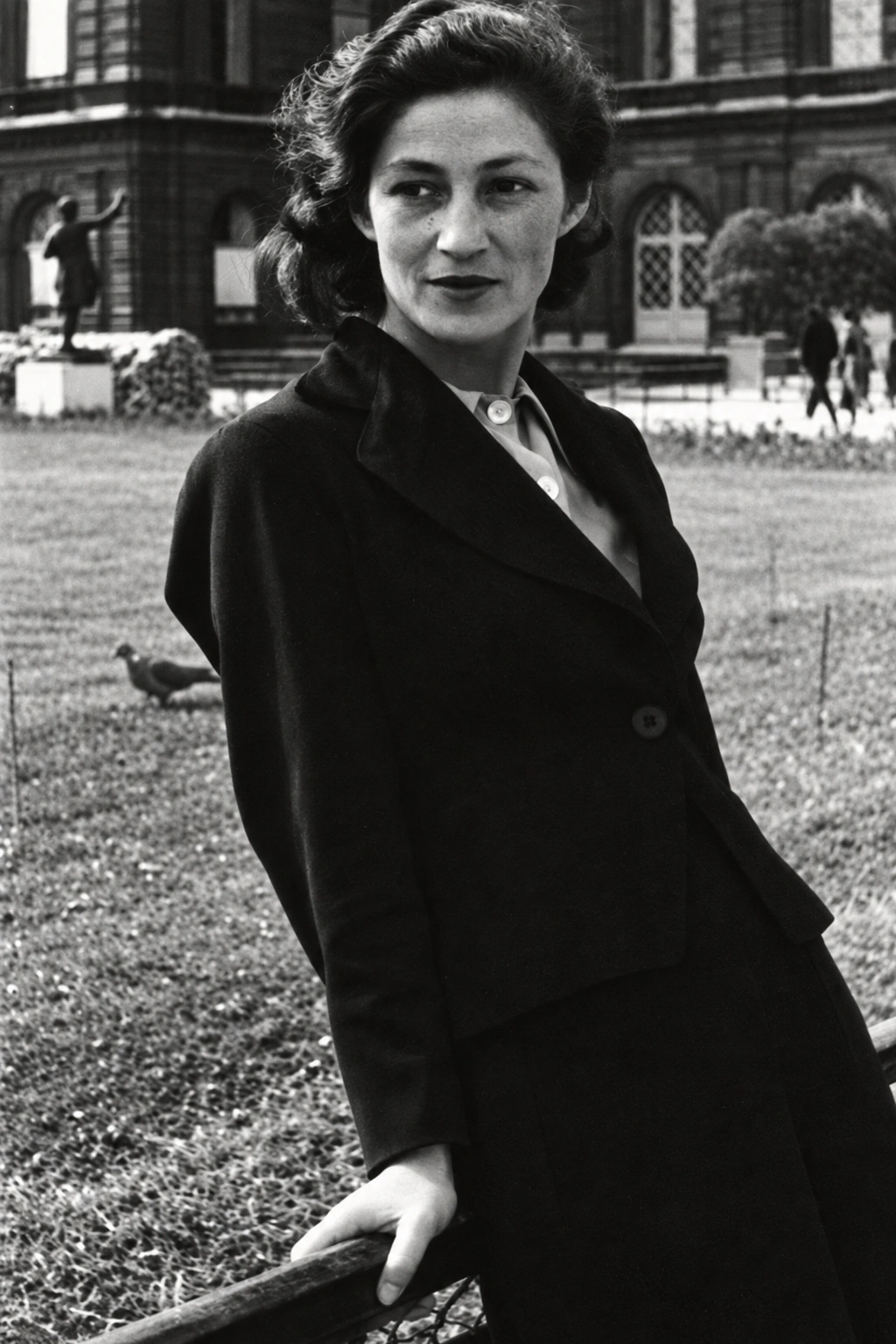
A Polish photographer and photojournalist, Julia Pirotte is known for the work she produced in Marseille during the Second World War, where she documented life under the Occupation, the Resistance and the Liberation of the city. A member of the FTP-MOI Resistance, her life was also marked by exile and, after the war, by an important body of photographic work in Poland.
A youth shaped by commitment
Julia Pirotte, born Gina Diament, came from Końskowola, in Poland, where she grew up in a poor Jewish family.
At a very young age she became involved in communist youth circles. At the age of 17 she was arrested on account of her political activities and spent several years in prison. In 1934 she left Poland with the help of International Red Aid (Secours rouge international) and reached Belgium.
In Belgium she married Jean Pirotte, a worker and trade union activist, whose name she would keep. There she also met Suzanne Spaak, a future resistance fighter. It was notably through the latter that she turned to photography and undertook training in the field. She then began a career as a photojournalist.
Exile and arrival in Marseille
In May 1940 the German invasion of Belgium forced Julia Pirotte to take the road of exile once again. She made her way to France and settled in Marseille.
She worked first in an arms factory, then as a photographer. From 1942 she became, in particular, a reporter for "Dimanche illustré" and also worked for other titles of the local press.
Her camera then became a means of bearing witness to the everyday reality of Marseille under the Vichy regime and during the Occupation.
She photographed in particular the working-class neighbourhoods of the Vieux-Port, the Jewish women and children interned at the Bompard centre, the families of miners in Gardanne, as well as various aspects of daily life in the Marseille region. Her photographs show the poverty, the harsh living conditions and the consequences of the war on the civilian population.
Among her photographs from this period is also a portrait of Édith Piaf. The Musée d’Histoire de Marseille holds this portrait, among others, in its collections.
Julia Pirotte in the Resistance
Alongside her work as a photographer, Julia Pirotte joined the French Resistance.
She joined the FTP-MOI — Francs-Tireurs et Partisans – Main-d’œuvre immigrée. Her clandestine activity was not limited to photography: she acted as a liaison agent, transported equipment, leaflets, underground newspapers and weapons, and took part in the production of forged papers.
Her work as a reporter also provided her with a cover that allowed her to move around and work in Marseille while taking part in clandestine activities.
Her commitment was part of that of the many foreign resistance fighters present in the south of France. Julia Pirotte was thus at once a photographer, a resistance fighter and a direct witness to the life of the population under the Occupation.
Bearing witness to the persecution of the Jews
A particularly important part of her photographic work concerns the Jewish people interned in Marseille.
She photographed in particular the foreign Jewish women and children interned at the Bompard camp. These images today constitute an important documentary testimony to the living conditions of the interned people before their deportation.
These photographs take on a particular dimension in her personal history. During the war Julia Pirotte lost a large part of her family. Her sister Mindla Diament, also involved in the Resistance, was arrested by the German authorities and executed in 1944.
The Liberation of Marseille
In August 1944 Julia Pirotte took part directly in the insurrection and the Liberation of Marseille.
On 21 August 1944 she was present alongside the resistance fighters and photographed the events. The sources of the Musée de la Résistance en ligne indicate that she took part in the fighting within the Marat company of the FTP-MOI and documented in particular the street fighting as well as the capture of the Prefecture by the resistance fighters.
Her camera thus enabled her to capture particularly important moments in the history of Marseille: the fighting, the resistance fighters in the streets, the inhabitants and the demonstrations that accompanied the Liberation.
Her photographs of Marseille in August 1944 today constitute one of the best-known parts of her work.
They are not merely reportage images: they also constitute a direct testimony to the commitment of the resistance fighters and to the days that saw the city free itself from the Occupation.
After the Liberation
Julia Pirotte remained in France for some time after the Liberation. She continued her photographic activity and worked in particular for several publications.
Her photographs from the Marseille period gradually formed an exceptional documentary body devoted to the Resistance, to daily life under the Occupation and to the Liberation.
In March 1946 she returned to Poland.
Return to Poland
Back in her native country, Julia Pirotte found a Poland deeply marked by the war and engaged in its reconstruction.
She resumed her work as a photographer and took part in the creation and running of a military photographic agency. The Żydowski Instytut Historyczny (Jewish Historical Institute) states that she was notably co-founder and director of the Wojskowa Agencja Fotograficzna (Military Photographic Agency) between 1946 and 1948.
She also worked as a photographer and journalist for several Polish publications.
Her lens now turned to the reconstruction of the country, social life and the people confronting the consequences of the war.
The Kielce pogrom
In July 1946 Julia Pirotte travelled to Kielce after the pogrom of 4 July.
She produced an important series of photographs documenting the consequences of the violence. The Żydowski Instytut Historyczny presents her as the photographer present in Kielce immediately after the pogrom and today holds part of this documentation.
Her photographs show in particular injured people in hospital, the victims and the funeral procession.
This documentation today constitutes a major photographic source for the memory of the Kielce pogrom. An important part of the photographs produced on this occasion has, however, not been preserved. The ŻIH indicates that more than a hundred pictures are said to have been taken and that a large part of them is said to have been confiscated by the Office of Security (Urząd Bezpieczeństwa) and probably destroyed.
The World Congress of Intellectuals in Wrocław
In 1948 Julia Pirotte photographed the World Congress of Intellectuals in Defence of Peace, held in Wrocław.
On this occasion she produced several portraits of intellectual and artistic figures present at the congress. Among the figures photographed are notably Pablo Picasso and Julian Tuwim. The Żydowski Instytut Historyczny holds part of this photographic output.
After the war, her photographic work remained mainly devoted to social questions and to daily life.
She photographed in particular the working-class population, children, the elderly and various aspects of the reconstruction of Poland.
A body of work long overlooked
Despite the importance of the work she produced during the war and after her return to Poland, Julia Pirotte remained for a long time relatively little known to the general public.
From the late 1970s and above all the early 1980s, her photographs taken in Marseille during the Occupation and the Liberation began to be rediscovered.
Friends from Marseille, former resistance fighters, helped to make her work known. In 1980 her photographs were shown at the Rencontres Internationales de la Photographie d’Arles. This exhibition contributed strongly to the recognition of her work.
Her photographs were then shown in several countries, notably in France, Belgium, Sweden, the United States and Poland. They gradually entered the collections of several photographic institutions.
The preservation of her work
An important part of Julia Pirotte’s photographic heritage is today held at the Żydowski Instytut Historyczny in Warszawa.
The institute states that Julia Pirotte entrusted it, shortly before her death, with part of her archives, comprising in particular around 1,000 photographs, mainly produced in the 1940s and 1950s, as well as archival documents relating to her professional activity and her commitment during the war. The collection also includes photographs of the battle of Marseille and important documentation on the Kielce pogrom.
Part of her work is also held at the Musée de la Photographie de Charleroi, in Belgium. Her photographs entered the collections of this institution following the rediscovery and international dissemination of her work.
A photographer, a resistance fighter, a witness
Julia Pirotte’s life is exceptional in the diversity of her commitments.
A press photographer, she used her camera to document the social and political realities of her time. A resistance fighter, she took part clandestinely in the struggle against the German Occupation within the FTP-MOI. In Marseille she was at once a protagonist and a witness of the Liberation.
After the war she continued this work of bearing witness in Poland. Her photographs of the Kielce pogrom in 1946, of the Wrocław Congress in 1948 and of the country’s reconstruction extended her gaze upon the political and social upheavals of post-war Europe.
Her work thus establishes a documentary link between several periods and several countries: Belgium, France and Poland.
Memory
Rediscovered several decades after the events she had photographed, Julia Pirotte is today recognised as an important photographer of the 20th century and as a witness to the Resistance and the Liberation of Marseille.
Her photographs make it possible to preserve the memory of people and events that marked European history: life under the Occupation, the commitment of foreign resistance fighters in France, the Liberation of Marseille, the consequences of the war and the Kielce pogrom.
Her life also recalls the role played by foreign and immigrant women in the French Resistance.
Julia Pirotte died in 2000. Her work, held notably in Warszawa and in Charleroi, has continued since then to be studied, exhibited and digitised.
Through her photographs, she leaves an exceptional testimony to the war years, the Resistance, the Liberation and the reconstruction of Europe.
Sources : Sources: Musée de la Résistance en ligne; Żydowski Instytut Historyczny (Jewish Historical Institute, Warszawa); Musée d’Histoire de Marseille; Musée de la Photographie de Charleroi.