
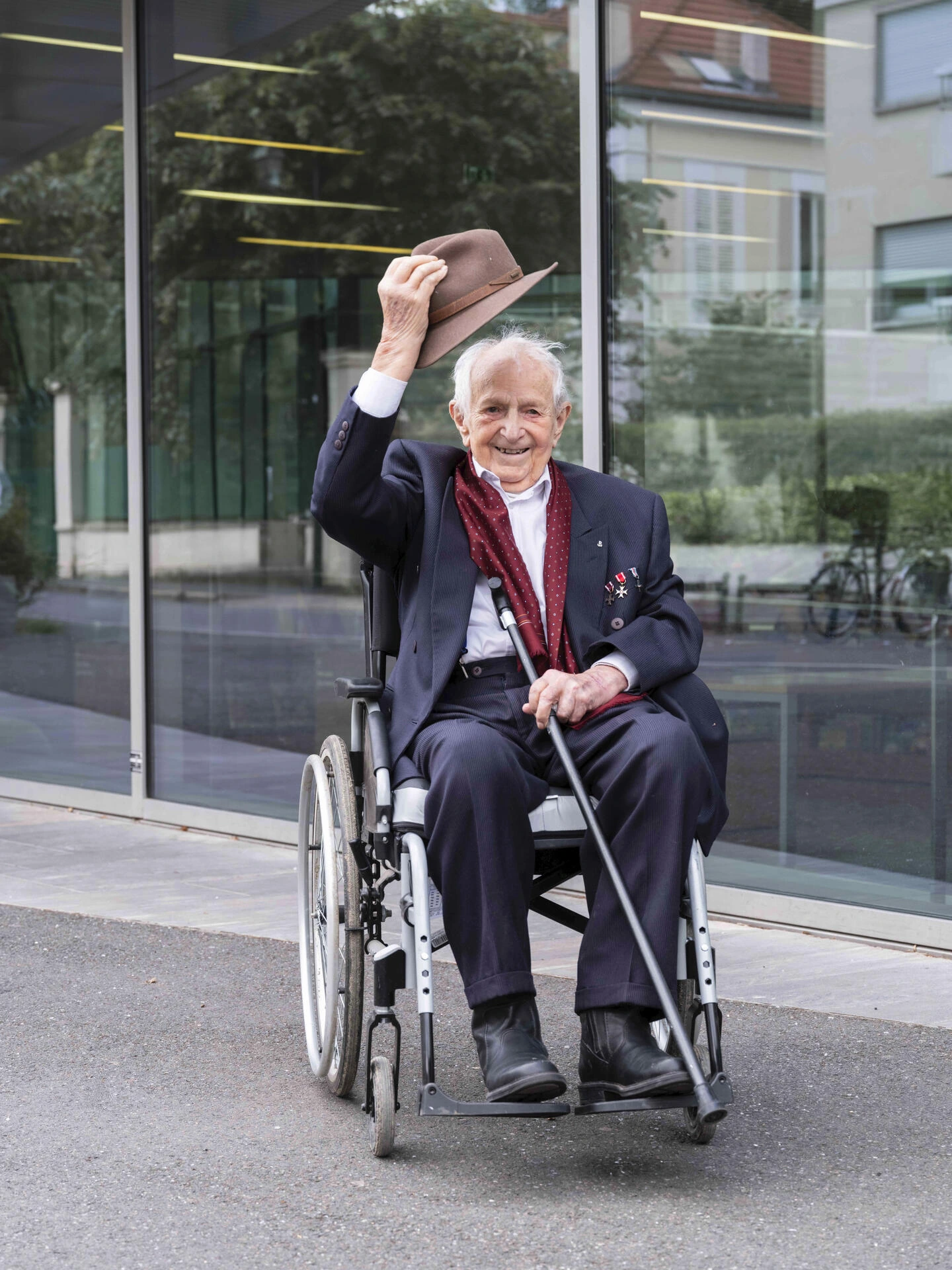
“I was 18 and my nerves were steady.” A fighter of the Polish Home Army (Armia Krajowa) and a mine-clearance specialist, Georges Szumanski fought in the 1944 Warsaw Uprising before going into exile in France. This is his testimony.
Before the war (1924-1939)
I was born on 4 August 1924 in Stanisławów, in Poland (today in Ukraine). My father, Mieczysław Szumański, was a serving officer, a captain; my mother, Maria Robinson, a lawyer. I grew up in a military family and attended primary and then secondary school in Warsaw, the capital.
My studies were interrupted by the outbreak of war in 1939. Like many young Poles, I was able to attend a clandestine high school.
Under German occupation (1939-1944)
In September 1942, at the age of 18, I joined the resistance in the ranks of the Polish Home Army (Armia Krajowa, AK), under the pseudonym “Wig”, in the Warsaw-Centre sector. I served in the B1 “Baszta” battalion and completed a four-month mine-clearance course, from May to August 1943.
I did not know at the time that my father was also in the resistance: in Warsaw he headed the Home Army’s Military Cartography Institute. During that period I saw him only two or three times.
The Warsaw Uprising (August-September 1944)
On 1 August 1944 the Warsaw Uprising began. I took an active part in it, as head of the mine-clearance section of the B1 “Baszta” battalion, in the Mokotów district. I was wounded, treated in a field hospital, and then returned to my unit.
“We were drunk on freedom regained, but we were poorly armed and the German repression was terrible.” When Mokotów capitulated, after an attempted escape through the sewers, I was taken prisoner on 28 September 1944 and transferred to the camp at Pruszków, near Warsaw. The city, 95% destroyed, would remain for me the symbol of a sacrifice needed to preserve the soul of Poland.
Escape and return to the underground (1944-1945)
On 3 October 1944 I escaped from the Pruszków camp. Back in Warsaw, I passed my baccalaureate in 1945 and began studies, but soon returned to the underground.
In June 1945 I left Warsaw for Wrocław and joined the clandestine organisation “WiN” (Freedom and Independence), of which my father was the regional head. I worked part-time in a factory and began studying architecture.
On the roads of exile (1945-1947)
In October 1945 my father received orders from his superiors to leave Poland; I went with him into exile. We escaped on foot to the Czechoslovak border, then by train to Germany, where I was enlisted in the Polish parachute brigade (British zone).
A new start in France (1947 to the present)
Demobilised in Paris in October 1947, I remained active in the Polish clandestine organisation “WiN”. I resumed university studies, alternating with periods of work, and became a town planner, a graduate of the Institute of Urban Planning of Paris. Married in 1958 to Agnès Prewysz-Kwinto, I returned to Poland for the first time in 1973, with my wife and daughters.
All my life I made a point of bearing witness to younger generations: “We must tell young people the truth. They must understand that democracy is precious, and that when it is lost, there is no knowing how long it will take to regain it.”
Honours
Cross of Military Valour · Cross of the Warsaw Uprising 1944 · Medal of Warsaw 1939-1945 · Knight’s Cross of the Order of Polonia Restituta (Rebirth of Poland).
In October 2024 a sabre of honour was presented to him by the Chief of the General Staff of the Polish Armed Forces, at a ceremony at the Embassy of Poland.
Sources : Testimony of Georges Szumanski, based on his autobiographical account Pologne, de l’ombre à la lumière (online: lettresetmemoires.net). Biographical details: Town of Bourg-la-Reine — BLR Mag. Published with the family’s permission.